Learning Quadrants
Discover how you learn best by understanding the Learning Quadrants.

The Importance of the Quadrants
Everyone learns in different ways and, understanding how we learn best can make studying more effective and less frustrating.
WanzWay uses four learning preference quadrants to describe common ways people take in, process, and work with information. Each quadrant highlights a different combination of thinking styles, using words or visuals, and focusing on concrete experiences or abstract ideas.
Most learners use all four styles at different times. These quadrants describe preferences, not limitations, and can change depending on the task or context. Knowing which styles feel most natural to you can help you choose learning strategies that work better for school, tutoring, and everyday problem-solving.
Meet the Learning Quadrants
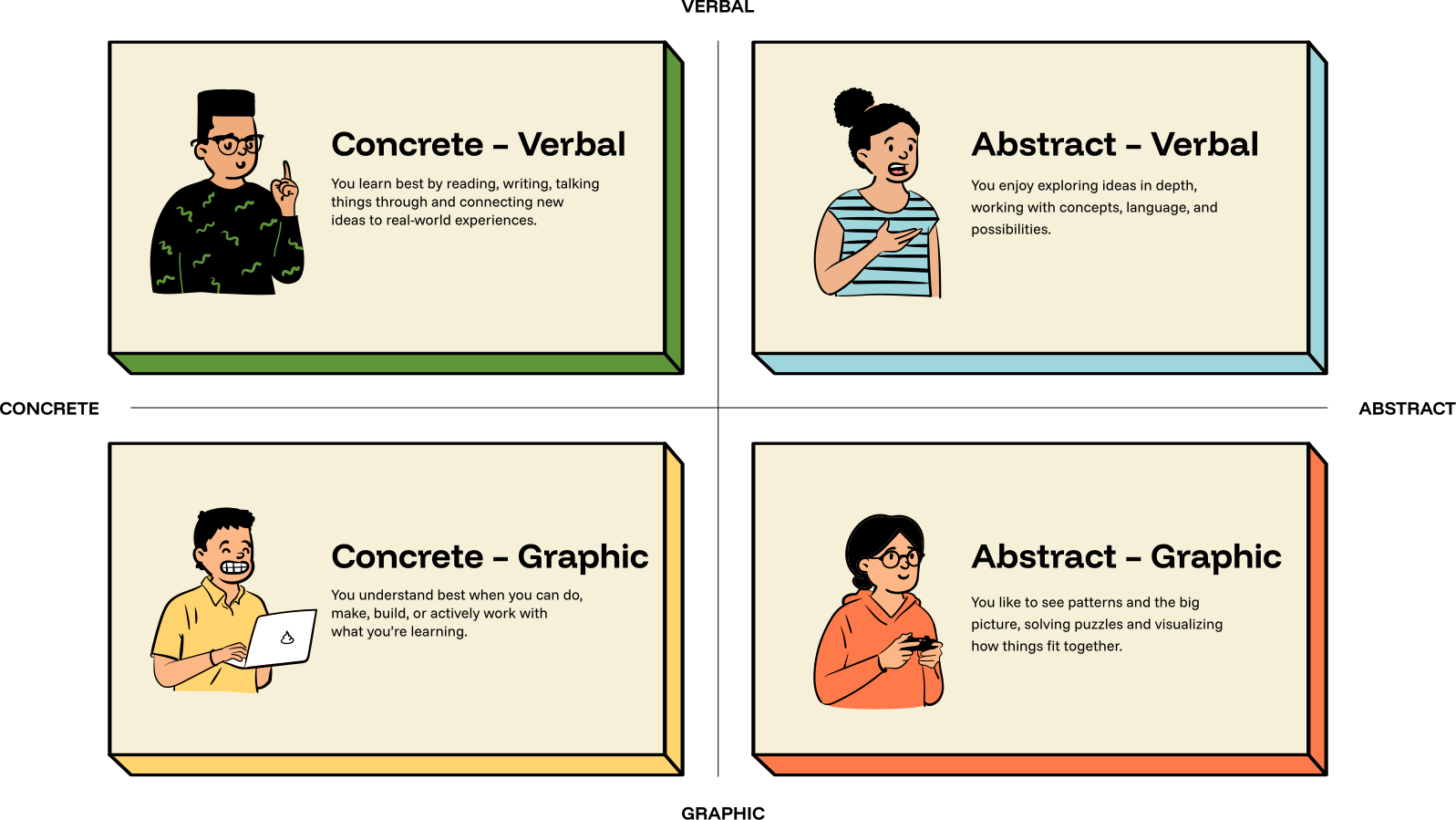
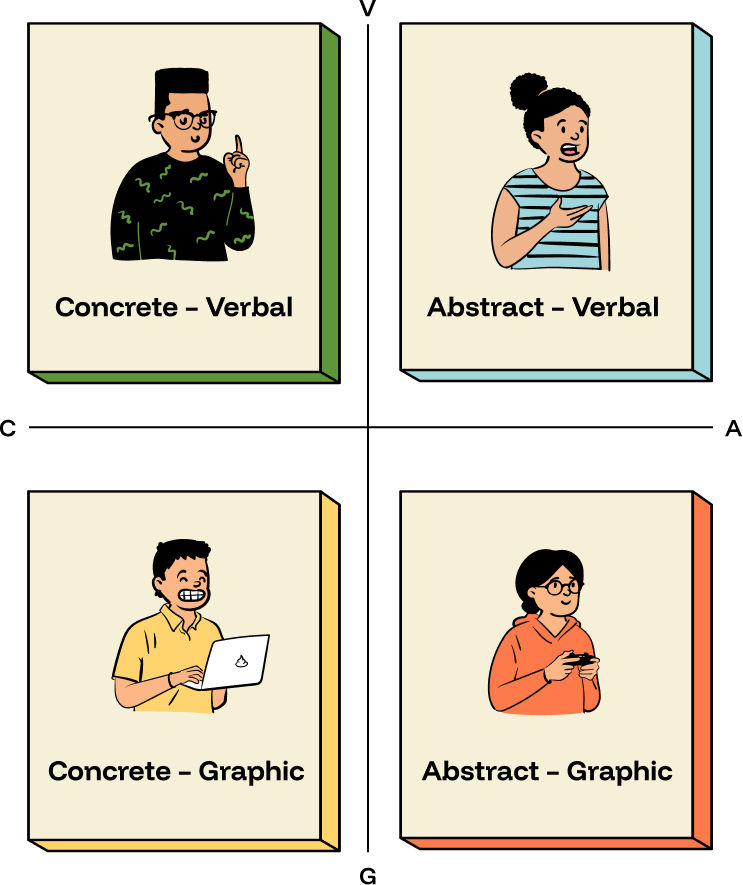
Concrete – Verbal
You learn best by reading, writing, talking things through and connecting new ideas to real-world experiences.
Abstract – Verbal
You enjoy exploring ideas in depth, working with concepts, language, and possibilities.
Concrete - Graphic
You understand best when you can do, make build, or actively work with what you’re learning.
Abstract - Graphic
You like to see patterns and the big picture, solving puzzles and visualizing how things fit together.

Abstract – Verbal (AV)
Conceptual + Word-Based
How you Learn
Learners in this quadrant enjoy working at research and logic. You are comfortable with research methods and prefer math and science. Imagination and reasoning play a strong role in how you make meaning.
Common Roles
- Poet
- Chartered Accountant
- Financial Officer
- Philosopher
- Scientist
- Researcher
- Analyst Writer
- Mathematician
Effective Learning Strategies
- Reading and discussing complex ideas or theories
- Writing essays, explanations, or creative responses
- Exploring “what if…” questions and hypothetical scenarios
- Debates and analytical discussions

Concrete – Verbal (CV)
Practical + Word-Based
How you Learn
Learners in this quadrant prefer clear language, structure, and step-by-step guidance. You learn best through words paired with hands-on or real-world experiences. You benefit from knowing why something matters and how it applies in practical situations. Focus and planning help you feel confident and engaged.
Common Roles
- Politician
- Journalist
- Salesperson
- Advocate
- Manager
- Teacher
Effective Learning Strategies
- Reading instructions, case studies, and real-world examples
- Writing reflections, summaries, or stories
- Group discussions and verbal explanation
- Role-playing or drama to act out scenarios
- Connecting concepts to everyday life or lived experiences

Graphic – Concrete (GC)
Doing + Making
How you Learn
Learners in this quadrant prefer to do and make. You learn best through visual information paired with hands-on activities. Diagrams, models, and physical interaction help you understand how things work in the real world. You benefit from tangible examples and practical application.
Common Roles
- Carpenter
- Engineer
- Health professional
- Technician
- Trades person
- Mechanic
- Builder
- Jazz musician, composer
Effective Learning Strategies
- Diagrams, charts, and visual step-by-step user guides
- Physical models, manipulatives, and tools
- Demonstrations and hands-on practice
- Games, simulations, and computer-based learning
- Building, testing, or assembling real objects
Abstract – Graphic (AG)
Conceptual + Visual
How you Learn
Learners in this quadrant think visually and imaginatively. You enjoy exploring ideas through images, patterns, and symbols rather than concrete examples alone. You are comfortable with ambiguity and often generate new ideas by visualizing possibilities and making creative connections.
Common Roles
- Artist
- Designer
- Architect
- Illustrator
- Innovator
- Fuzzy Mapper
Effective Learning Strategies
- Visual brainstorming, sketching, concept and fuzzy mapping, icons, and symbols
- Drawing, painting, designing, or prototyping ideas
- Using symbols, icons, acronyms, and visual metaphors
- Exploring “what if…” scenarios visually
- Combining storytelling with imagery